No products in the cart.
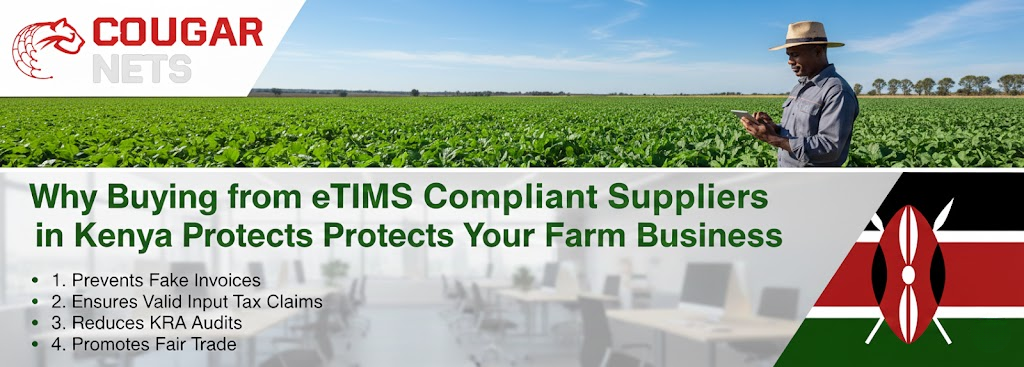
Why Buying from eTIMS Compliant Suppliers in Kenya Protects Your Farm Business
Agriculture in Kenya has evolved into a structured, commercially driven sector where documentation, compliance, and financial accountability are as important as production itself. Commercial farmers, greenhouse operators, agricultural contractors, and agribusiness investors now operate in an environment where every purchase must be traceable, justifiable, and legally recognized.
One of the most overlooked risks in agricultural procurement is buying farm inputs from informal vendors who cannot issue legally valid tax documentation. While such purchases may appear cheaper at the point of sale, they often introduce serious financial, legal, and operational exposure. This is why working with eTIMS compliant suppliers in Kenya, such as Cougar Nets, is a business protection strategy rather than just a sourcing decision.
Understanding eTIMS in Practical Business Terms
The electronic Tax Invoice Management System (eTIMS) is the Kenya Revenue Authority’s framework for validating business transactions through compliant tax invoicing. It ensures that sales and purchases are recorded in a standardized, verifiable format linked to registered businesses.
For commercial agricultural operations, items such as shade nets, greenhouse nets, windbreak nets, fencing nets, and crop protection nets are not casual purchases. They are operational assets and business expenses. These expenses must be supported by proper tax documentation to qualify under accounting, tax reporting, and audit requirements.
If a supplier is not eTIMS compliant, the invoice issued may not meet KRA validation standards. This creates several consequences. The expense may be disallowed during tax filing. Accounting records may show inconsistencies. During audits or financial reviews, undocumented or improperly documented purchases can attract scrutiny. In some cases, businesses may end up paying higher taxes simply because legitimate operational costs cannot be substantiated.
In short, without a KRA-valid invoice generated through a compliant system, the financial integrity of the purchase is weakened.
The Risk of Informal Agricultural Input Sellers
Informal roadside vendors or unregistered dealers often operate outside structured compliance systems. While they may provide immediate availability and seemingly lower prices, they typically cannot offer:
-
Tax invoices linked to a registered business PIN
-
eTIMS validated receipts
-
Formal product documentation
-
Structured after-sales accountability
For small, informal farms, this may seem manageable. For commercial-scale operations, it creates measurable risk.
First, expenses that cannot be properly documented may not qualify as deductible business costs. Over time, this increases the effective cost of operations through higher tax exposure.
Second, during financial audits, loan applications, or investor due diligence, undocumented purchases create red flags. Financial institutions and investors assess not only profitability but also governance and compliance discipline. Poor procurement documentation can delay approvals or reduce credibility.
Third, if products fail prematurely or do not meet expected specifications, informal sellers rarely provide enforceable recourse. There is limited legal traceability and no structured accountability.
Fourth, agricultural contractors who procure materials on behalf of clients must maintain transparent procurement trails. Using non-compliant sources can damage professional reputation and strain client relationships.
Compliance as a Form of Business Protection
Working with an eTIMS compliant supplier like Cougar Nets shifts procurement from an informal transaction to a protected business process.
When you buy shade nets in Nairobi or anywhere in Kenya from a compliant supplier, the transaction becomes part of your formal financial ecosystem. The invoice supports expense accounting, tax reporting, and audit defense. The purchase can be traced back to a registered entity, providing legitimacy and accountability.
This level of structure reduces multiple layers of risk. It protects tax filings by ensuring expenses are recognized. It strengthens loan and grant applications by demonstrating disciplined procurement practices. It supports investor reporting by maintaining clean financial records. It also protects operational continuity because disputes over product quality or specifications are handled within a formal supplier framework.
For businesses that prioritize stability and long-term growth, working with a structured supplier through Cougar Nets is part of responsible procurement governance.
Who Should Prioritize eTIMS Compliant Suppliers
The need for compliant agricultural suppliers increases with the scale and structure of the operation. It is especially important for commercial farm owners, greenhouse project developers, agricultural contractors, agribusiness investors, NGOs, export-oriented producers, and corporate farms. In these environments, procurement decisions are scrutinized beyond price. Documentation, traceability, and governance standards are equally important.
The True Cost of “Cheap” Procurement
The perception of saving money by buying from informal sources often ignores downstream costs. Disallowed tax deductions increase effective expenditure. Accounting corrections consume time and resources. Audit issues can lead to penalties or reputational harm. Financing delays can stall expansion plans.
When viewed holistically, the small upfront price difference is often insignificant compared to the financial and operational risk introduced.
Professional agriculture requires procurement practices that match the scale and seriousness of the business.
A Structured Approach to Buying Agricultural Nets
Before purchasing agricultural netting products, decision-makers should verify that the supplier is properly registered, transactions are supported by eTIMS compliant invoicing, a KRA valid invoice will be issued, and the documentation can withstand audit or financial review. If any of these conditions are not met, the risk transfers to the buyer.
Choosing a compliant supplier ensures that agricultural inputs are not only technically suitable for crop protection but also financially defensible within the business system.
Final Perspective
Modern farming operates at the intersection of production and compliance. Inputs like shade nets are part of the physical farm infrastructure, but they are also entries in financial statements, tax returns, and audit files. Ignoring this dual role exposes the business to unnecessary risk.
Sourcing from eTIMS compliant suppliers in Kenya ensures that farm inputs are aligned with both operational needs and financial governance standards. It protects accounts, strengthens compliance, and reinforces business credibility in a sector that is becoming increasingly structured and scrutinized.
Professional procurement is not an administrative burden. It is a foundation for sustainable agribusiness growth.
Contact Cougar Nets for a Compliant Quote
For properly documented agricultural net supplies supported by valid tax invoicing, work directly with a structured supplier.
Cougar Nets
Email: sales@cougarnets.com | info@cougarnets.com
Phone: +254 706 903 465
Visit: Darosa Plaza, Karen Rd, Nairobi
Website: https://cougarnets.co.ke/