No products in the cart.
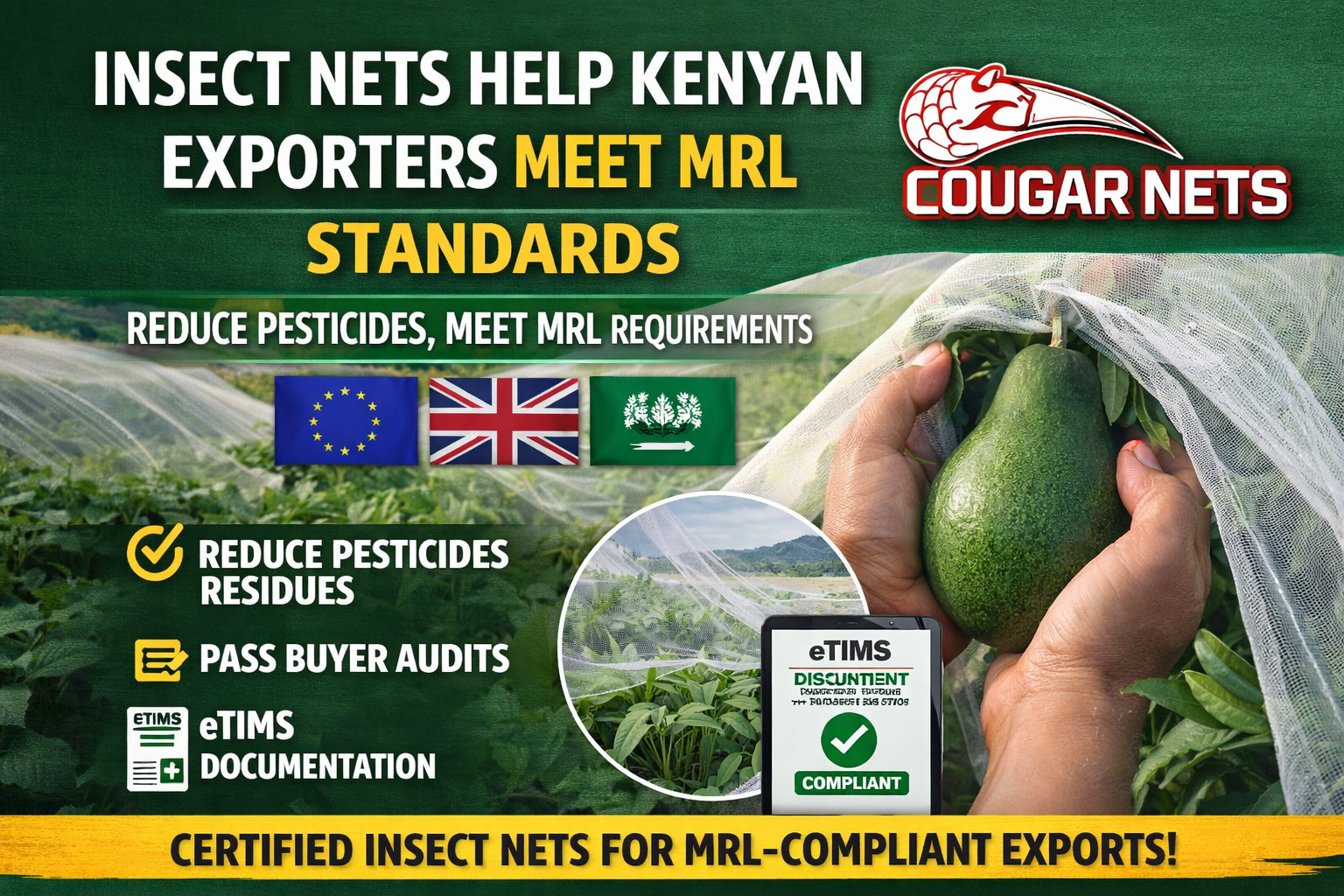
Insect nets export crops Kenya are high-density, UV-stabilized mesh systems that physically block pests, reduce pesticide use, and help farms meet strict Maximum Residue Limit (MRL) requirements for EU, UK, and Middle East export markets. Cougar Nets supplies certified insect nets with valid eTIMS invoices, enabling agribusinesses to remain compliant, audit-ready, and competitive in 2026.
Insect nets export crops Kenya are no longer an optional upgrade for serious exporters. As global markets tighten residue controls and buyer audits become more frequent, Kenyan farmers exporting vegetables and fruits must demonstrate pest control methods that minimize chemical input while maintaining yield quality. Physical exclusion using insect nets has become one of the most effective, regulator-approved strategies for meeting MRL standards while protecting profitability.
Understanding MRL Standards for Crop Exporters
Maximum Residue Limits (MRLs) define the highest allowable pesticide residue on food products intended for human consumption. Export markets enforce these limits rigorously:
-
European Union: Zero-tolerance mindset for repeated residue breaches
-
United Kingdom: Strict post-Brexit compliance aligned with EU benchmarks
-
Middle East: Increasingly harmonized with Codex Alimentarius standards
Kenyan exporters shipping French beans, snow peas, avocados, capsicum, tomatoes, and herbs are frequently rejected due to pesticide residue violations. These rejections result in financial loss, contract termination, and reputational damage.
This is where insect nets for export crops Kenya become a strategic compliance tool.
Why Chemical Pest Control Alone Fails MRL Compliance
Traditional pesticide-heavy pest management creates three major risks:
-
Residue Accumulation: Frequent spraying increases the chance of exceeding MRL thresholds.
-
Short Pre-Harvest Intervals: Export timelines often do not allow sufficient residue breakdown.
-
Audit Red Flags: Buyers increasingly demand evidence of Integrated Pest Management (IPM), not chemical dependency.
In contrast, physical pest exclusion using insect nets reduces insect pressure at the source, lowering the need for spraying and supporting MRL compliance organically.
How Insect Nets Reduce Pesticide Residues
Insect nets export crops Kenya work by creating a physical barrier between crops and common pests such as aphids, thrips, whiteflies, leaf miners, and moths.
Key residue-reduction mechanisms:
-
Prevents pest entry, reducing infestation levels
-
Minimizes chemical spraying frequency
-
Allows targeted, low-residue treatments only when necessary
-
Supports biological control programs under IPM frameworks
This approach aligns perfectly with GlobalG.A.P, KEPHIS, and EU buyer protocols.
Technical Specifications That Matter for MRL Compliance
Not all insect nets are equal. Export-grade insect nets must meet specific technical standards:
| Specification | Export-Grade Requirement | Cougar Nets Standard |
|---|---|---|
| Mesh Size | 40 mesh or higher | 40 mesh certified |
| Material | UV-stabilized HDPE | Premium HDPE |
| UV Resistance | 5–7 years | Tested for Kenyan UV |
| Airflow Balance | High | Optimized mesh density |
| Tensile Strength | High | Reinforced edges |
| Compliance Documentation | Mandatory | eTIMS-supported |
Cougar Nets’ Insect Nets (40 Mesh) meet export-grade requirements for both vegetables and fruit orchards.
Export Crops That Benefit Most from Insect Nets
Vegetables
-
French beans
-
Snow peas
-
Sugar snaps
-
Capsicum
-
Tomatoes
-
Chillies
Fruits
-
Avocados
-
Mangoes
-
Berries
-
Passion fruit
High-value export zones such as Naivasha, Meru, Kirinyaga, Murang’a, and Kiambu are increasingly adopting insect nets to protect contracts with EU buyers.
Insect Nets vs Chemical Control: MRL Impact Comparison
| Factor | Insect Nets | Chemical-Only Control |
|---|---|---|
| Pesticide Residue Risk | Very Low | High |
| Export Rejection Risk | Minimal | Significant |
| Compliance with IPM | Strong | Weak |
| Long-Term Cost | Lower | Higher |
| Buyer Audit Score | High | Low |
This data explains why insect nets for export crops Kenya are now considered a best-practice investment rather than an optional input.
Integration with Shade Nets and Trellis Systems
Export farms often combine insect nets with other netting systems to optimize microclimate and crop structure:
-
Shade Nets regulate temperature and light
-
80% GSM Shade Net protects sensitive crops
-
Trellis Nets improve airflow and reduce disease pressure
This integrated system further reduces chemical dependency, directly supporting MRL compliance.
eTIMS Compliance and Export Audit Readiness
In 2026, eTIMS compliance is critical for agribusiness exporters:
-
Export audits require traceable procurement records
-
VAT deductions are only allowed with eTIMS invoices
-
Corporate accounting systems must match KRA records
All insect nets for export crops Kenya purchased from Cougar Nets are supported by valid eTIMS invoices, ensuring:
-
Tax compliance
-
Audit readiness
-
Transparent supply chain documentation
This is particularly important for exporters supplying EU supermarket chains and Middle Eastern distributors.
Common Mistakes Exporters Make with Insect Nets
-
Buying low-quality mesh that degrades under UV
-
Using incorrect mesh size that allows pest penetration
-
Purchasing from informal suppliers without eTIMS invoices
-
Poor installation leading to gaps and pest entry
Cougar Nets provides expert guidance to avoid these errors, ensuring full compliance from installation to harvest.
Case Study: French Bean Exporter – Naivasha
A mid-sized French bean exporter faced repeated shipment rejections due to thrips residue. After installing Cougar Nets insect nets:
-
Chemical spraying reduced by 60%
-
Residue levels fell below EU thresholds
-
Export contracts reinstated
-
VAT deductions successfully claimed using eTIMS invoices
This demonstrates the real-world impact of insect nets for export crops Kenya.
Case Study: Avocado Orchard – Murang’a
An avocado exporter supplying the EU market adopted insect net perimeter protection combined with shade nets:
-
Reduced fruit fly pressure
-
Improved cosmetic quality
-
Passed GlobalG.A.P audit
-
Achieved full MRL compliance
Why Cougar Nets Is the Trusted Supplier for Export Farms
-
Certified, export-grade insect nets
-
UV-stabilized HDPE for Kenyan climates
-
eTIMS-supported invoicing for audits and tax
-
Nationwide and East Africa delivery
-
Bulk orders and custom sizing available
Explore related solutions:
Frequently Asked Questions About Insect Nets and MRL Compliance
Are insect nets accepted by EU buyers?
Yes. Physical pest exclusion is strongly recommended under IPM frameworks.
Do insect nets completely eliminate pesticides?
They significantly reduce usage, making compliance achievable.
Is eTIMS mandatory for export supplies?
Yes. Export audits and VAT deductions require eTIMS documentation.
How long do insect nets last?
5–7 years with proper UV stabilization.
Insect nets export crops Kenya are one of the most effective tools available to farmers aiming to meet MRL standards in 2026 and beyond. By reducing pesticide dependence, improving audit outcomes, and supporting legal tax compliance through eTIMS, insect nets protect both crops and export revenue. Cougar Nets delivers certified, durable, and compliant solutions trusted by Kenya’s leading exporters.
Export with Confidence Using Certified Insect Nets
For reliable insect nets that help you meet MRL standards, reduce chemical residues, and pass export audits, choose Cougar Nets.
Nationwide & East Africa Delivery Available
Premium quality nets ✔ Export-grade compliance ✔ eTIMS invoices ✔ Bulk and custom solutions ✔ Serving Kenya (Nairobi, Eldoret, Kisumu), Uganda, Tanzania, Rwanda, South Sudan, Ethiopia.
Contact Us for a Quote
Email: sales@cougarnets.com | info@cougarnets.com
Phone: +254 706 903 465
Visit: Darosa Plaza, Karen Rd, Nairobi
Website: https://cougarnets.co.ke/